

Projects and Collaborations
The Effelsberg-Bonn HI Survey (EBHIS)
The Effelsberg-Bonn HI Survey is a scientific project headed by the Argelander-Institut für Astronomie (PI J. Kerp) in collaboration with the Max-Planck-Institut für Radioastronomie. The project is funded by the Deutsche Forschungsgemeinschaft (grants KE757/7-1 to 7-3).Abstract

Compared to current HI surveys like the Parkes Galactic all-sky survey (GASS) or the extragalactic HI Parkes all-sky (HIPASS) the EBHIS is even with its first coverage at a comparable sensitivty level. With the anticipated sensitivity and an advanced calibration scheme this survey will be superior to current northern HI survey, the Leiden-Argentine-Bonn survey, and will answer fundamental questions on the baryon budget, the HI mass function, and the gas phase properties that have not been addressed before. In addition the higher angular resolution allows to study the HI emission in the Milky Way in much greater detail and provides important clues on structure formation and the extraplanar gas. Apart from its own science goals the EBHIS data base provides crucial information to a broad range of science investigation, such as high energy physics (gamma & X-ray astronomy), absorption line surveys or dark matter science with FERMI.
The EBHIS raw data are calibrated and imaged via an automated pipeline and the first release of the full-sky coverage will be available in January 2016. The data products and calibration information will be directly available via an Internet interface as a service to the astronomical community.
The EBHIS survey is a well designed project that has formed a unique HI group that builds up expertise in data calibration and data management, that leads naturally to the science of the next generation radio telescopes. Furthermore, the scope of being involved in state of the art science and technical developments for next generation radio telescopes is attractive for young students to consider a career in radio astronomy. Finally, the well calibrated EBHIS survey has the potential to become the reference database of short spacing measurements for the up-coming HI surveys which are planned for the SKA pathfinder telescopes in Australia (ASKAP) and South Africa (MeerKAT) and the Westerbork Synthesis Telescope APERTIF survey.
Introduction: Lecture on the value of radio astronomy as a scientific field and outline its historical development.
Electromagnetic radiation: Lecture that recalls the basics of electromagnetic waves. The wave equation is derived and solved, and the basic construction of a receiver is presented.
Radiometer: Lecture on the radiometer, construction, function and properties. Semiconductors, diodes, transistors, noise and signal processing, as well as hot-cold calibration.
Dicke receiver & atmosphere: Systematic variations of the amplifier, Dicke receiver, Kirchhoff's law of thermodynamics, atmospheric opacity, sky dip, refraction, Faraday rotations, and windows to the universe.
Lecture notes (PDFs)
First Lecture: Introduction
Second Lecture: Electromagnetic waces and oscillations
Third Lecture: Radiometer construction, noise
Fourth Lecture: Dicke Receiver, Atmospheric Windows, Sky Dip
Basics of radio astronomy, draft version (PDF)
Basics of radio astronomy (draft)

MALS
The MeerKAT Absorption Line Survey (MALS) consists of 1655 hrs of MeerKAT time (anticipated raw data ~ 1.7 PB) to carry out the most sensitive search of HI and OH absorption lines at 0<z<2, the redshift range over which most of the cosmic evolution in the star formation rate density takes place (https://mals.iucaa.in/, 24th Nov 2025).
Press Release (EN) and Press Release (DE) MeerKAT Absorption Line Survey (MALS), 2nd April 2025.
Press Release (EN) MALS by IUCAA, 2nd April 2025.
eROSITA
The primary science driver for eROSITA is to study dark energy with about 100,000 galaxy clusters. eROSITA was launched in 2019 and completed four full-sky surveys at X-ray wavelengths.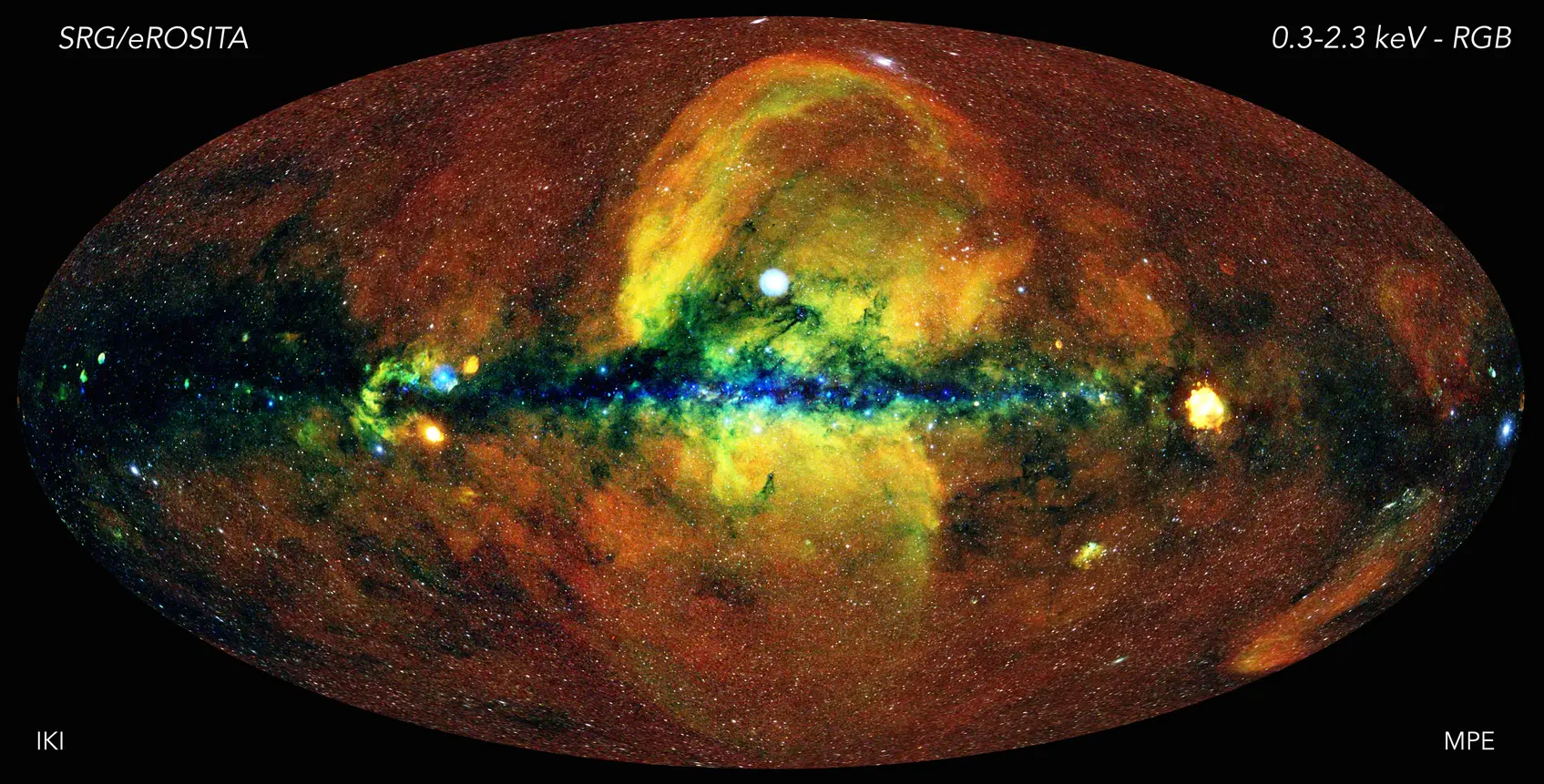
WALLABY/ASKP
WALLABY is the "Australian Square Kilometre Array Pathfinder (ASKAP) HI All-Sky Survey", a precursor for future, much deeper SKA Phase 1 & Phase 2 neutral hydrogen surveys. The aim of WALLABY is to observe three-quarters of the whole sky in the 21-cm line of neutral hydrogen (or HI) at 30-arcsec resolution, thereby detecting and imaging the gas distribution in hundreds of thousands of external galaxies in the local Universe.